Table of Contents
- Where Mass Appraisal Can Create Same-Street Disparities
- Why Same-Street Evidence Matters in an ARC Appeal
- The Real Question: Is Your Property Above Its Peer Baseline?
- Why Broad Neighborhood Comparisons Can Miss the Best Evidence
- The Strategic Pivot: Isolate the Strongest Equity Evidence
- Stop Overlooking the House Two Doors Down
- 💡 Trivia Time: What Exactly Is an SBL Number?
Walk down almost any residential block in Massapequa, Garden City, or Bethpage, and you will notice a familiar pattern: homes of similar style, size, and construction era lined up on the same street.
Yet a closer review of Nassau County property records can reveal a surprising disparity.
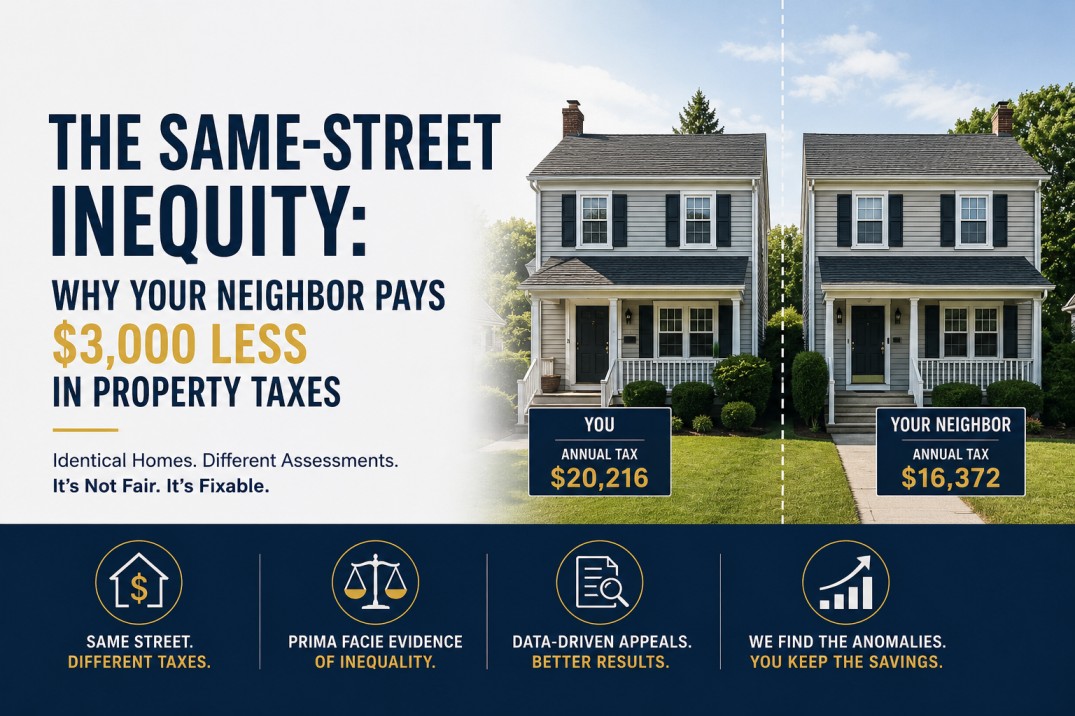
In some cases, two closely comparable Colonials on the same block carry materially different assessment baselines—differences large enough to translate into thousands of dollars in annual tax exposure.
This is not always explained by obvious factors such as location, property style, or living area. Instead, the disparity may reflect inconsistencies in the assessment roll, outdated property assumptions, or limitations of mass-appraisal methods.
For homeowners preparing to challenge a tentative assessment, a same-street discrepancy can become one of the most persuasive forms of comparative evidence available.
Where Mass Appraisal Can Create Same-Street Disparities
Nassau County does not conduct a fresh, individualized interior appraisal of every residential property each year. Instead, the Department of Assessment relies on county property records and large-scale valuation methods to establish values across the roll.
These models may consider recorded property characteristics such as:
- Property style
- Gross living area
- Structural grade
- CDU or condition-related indicators
- Geographic location
- Lot and improvement data
Mass appraisal is designed to process large numbers of properties efficiently. But when two homes appear highly similar in the public record and still receive materially different valuation baselines, an important question emerges:
Why is one property being carried significantly higher than a closely comparable peer on the same block?
Consider the following same-street comparison:
| Property Attribute | Your Home — Subject Property | Direct Neighbor — Street Peer | What Stands Out |
|---|---|---|---|
| Geographic Block | Section X, Block Y | Section X, Block Y | Same block |
| Property Style | 2-Story Colonial | 2-Story Colonial | Same architecture |
| Gross Living Area | 2,401 sq. ft. | 2,401 sq. ft. | Same footprint |
| Structural Grade / CDU | Grade B / Good | Grade B / Good | Same recorded quality indicators |
| County Fair Market Value | $872,979 | $707,000 | +$165,979 difference |
| Taxable Assessed Value | $873 | $707 | +$166 fractional gap |
| Estimated Annual Tax Burden | $20,216 | $16,372 | +$3,844 potential annual difference |
Note: Estimated tax burden is illustrative and depends on the property’s specific school, town, village, and special-district tax rates.
The county records classify both structures similarly in size, style, and quality indicators, yet assign materially different valuation baselines on the same block.
Whether the gap reflects historical roll inconsistencies, imperfect data inputs, or limitations of mass appraisal, the practical issue for the homeowner is the same:
A highly comparable neighboring property may be carried at a substantially lower assessment baseline.
Why Same-Street Evidence Matters in an ARC Appeal
When a homeowner files an appeal with the Nassau County Assessment Review Commission, the claim must be supported by evidence. General frustration that “taxes are too high” is not enough.
ARC reviewers evaluate the strength of the supporting data.
That is why comparable-property evidence matters.
A persuasive same-street comparison may involve homes that share:
- The same Section and Block
- Similar lot positioning
- The same property style
- Comparable square footage
- Similar county-recorded grade and condition indicators
- A materially lower assessment baseline
This type of comparison can create a focused argument that your property may be assessed inconsistently relative to a closely comparable peer.
A Simple Same-Block Illustration
-
[Section: X] ➔ [Block: Y] ➔ [Lot A1: Your Home] ➔ Assessed Value: $873
-
[Section: X] ➔ [Block: Y] ➔ [Lot A2: Comparable Peer] ➔ Assessed Value: $707
Privacy Note: X and Y represent the same Section and Block, while A1 and A2 represent nearby parcels.
When a comparable property shares the same localized block environment and closely matches the subject property’s recorded characteristics, it becomes harder to dismiss the valuation gap as merely a difference in neighborhood or broad market conditions.
That does not automatically prove unequal assessment on its own. But it can establish a strong same-block equity benchmark that deserves careful review.
The Real Question: Is Your Property Above Its Peer Baseline?
A homeowner does not need to argue that their house is “cheap” or that the broader real estate market is weak.
A much sharper appeal question is:
Is my property being carried materially higher than the most comparable homes nearby?
That distinction matters.
The strongest appeal narrative is often not:
My taxes feel too high.
It is:
My property’s assessment appears inconsistent with closely comparable homes in the same immediate assessment environment.
This is where same-street and same-block analysis becomes powerful. It removes noise from the comparison and focuses the appeal on properties that are geographically and structurally difficult to ignore.
Why Broad Neighborhood Comparisons Can Miss the Best Evidence
Traditional tax grievance methods often rely on broad neighborhood averages or comparable properties selected from farther away.
Those comparisons may still be useful, but they can introduce unnecessary variability:
- Different school districts
- Different micro-locations
- Different lot configurations
- Different home styles
- Different property condition profiles
- Different assessment histories
The farther the comparable moves away from the subject property, the easier it becomes to challenge the relevance of the comparison.
To build a stronger equity argument, precision matters.
Rather than relying on a high volume of loosely related properties, the better strategy is to identify the most comparable lower-assessed peers—especially those sharing the same block profile and highly similar county-recorded characteristics.
The Strategic Pivot: Isolate the Strongest Equity Evidence
FairValue AI is designed to uncover the type of property-level disparity that can be missed by generic grievance workflows.
Our data engine audits more than 340,000 Nassau County property records to identify:
- Same-street assessment gaps
- Section-Block-Lot anomalies
- Highly comparable lower-assessed peers
- Valuation outliers within local peer groups
- Property-level equity arguments that deserve closer review
The goal is not to overwhelm the appeal with noisy data.
The goal is to isolate the clearest, most persuasive evidence that your property’s assessment may sit above its true local equity benchmark.
Stop Overlooking the House Two Doors Down
Sometimes the most important evidence in a property tax appeal is not a distant sale, a broad market statistic, or a countywide average.
It is the house next door.
If a closely comparable home on your same block carries a materially lower valuation baseline, that gap may represent a meaningful opportunity to challenge your own tentative assessment.
Stop leaving strong local evidence unexplored.
Scan your property at fairvaluetax.com to cross-reference your Section-Block-Lot profile, identify relevant same-street comparisons, and generate a data-backed property valuation audit ahead of the 2027 filing cycle.
💡 Trivia Time: What Exactly Is an SBL Number?
Every parcel of land in Nassau County is assigned a unique, three-part tax map identifier known as the Section-Block-Lot, or SBL, number.
- Section: A broad geographic area within the county tax map
- Block: A more specific local grouping of parcels, often corresponding to a highly localized street area
- Lot: The individual parcel identifier for a specific property
When property tax professionals look for highly relevant nearby comparisons, Section and Block matching can be especially useful because those properties often share a very similar immediate assessment environment.
That is why same-block peers can play such an important role in identifying potential assessment inequities.