Table of Contents
- Direct Answer
- Evidence Type 1: Comparable Sales
- Evidence Type 2: Assessment Equity
- Evidence Type 3: Property Condition
- Evidence Type 4: Recent Purchase Price
- Evidence Type 5: Documentation
- Weak Evidence to Avoid
- How FairValue Structures Evidence
- Evidence Summary Table
- Final Takeaway
A Nassau County property tax grievance is not won by saying your taxes feel too high.
It is supported by evidence showing that the County’s assessment is too high relative to the property’s actual market value, comparable sales, similar nearby assessments, or property-specific facts.
The core question is simple:
What evidence shows that Nassau County’s value for your home is unsupported?
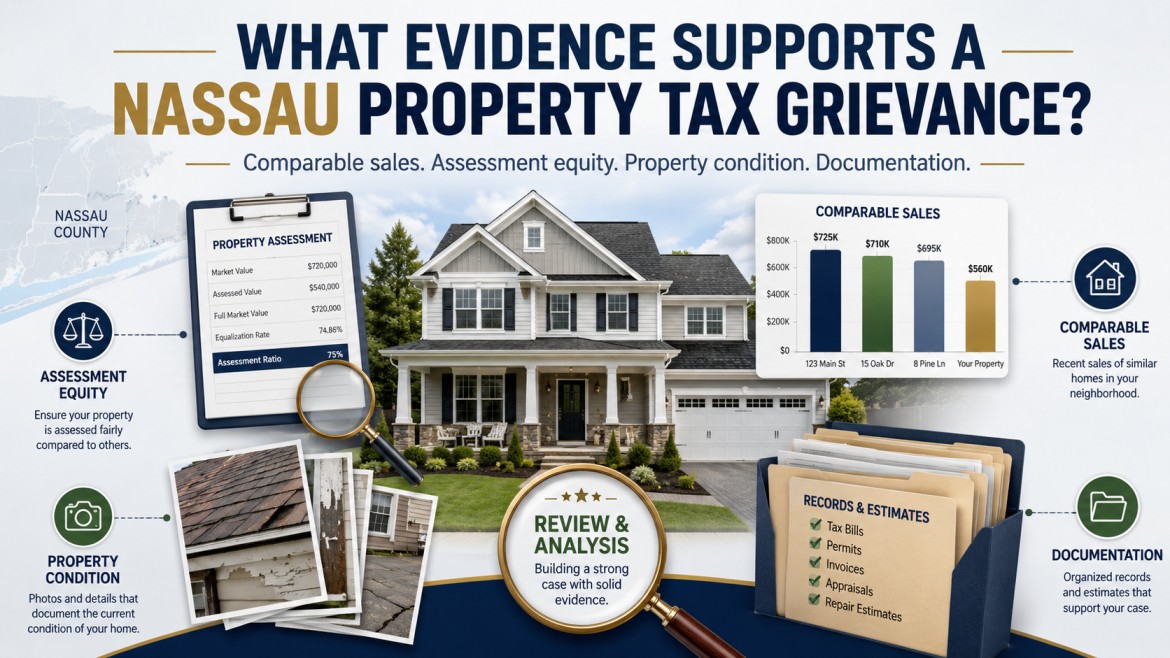
For most residential homeowners, the strongest evidence is a structured combination of:
- Comparable sales;
- Assessment equity comparisons;
- Property condition documentation;
- Recent purchase price, when relevant;
- Official records, photos, and repair estimates.
New York State guidance explains that a homeowner seeking a reduced assessment must support the claim that the property is over-assessed, and that comparable sales are often the best way to support a residential case. :contentReference[oaicite:0]{index=0}
Direct Answer
Strong Nassau property tax grievance evidence usually connects four things:
| Evidence Layer | What It Shows |
|---|---|
| County Value | What Nassau currently says your property is worth. |
| Market Evidence | What similar homes actually sold for. |
| Equity Evidence | How similar nearby homes are assessed. |
| Property Facts | Whether your home has defects, outdated features, or record errors. |
A strong filing does not rely on one isolated number.
It explains why the County’s assessment is too high using a clear evidence chain:
County value → comparable sales → assessment equity → property-specific explanation.
Evidence Type 1: Comparable Sales
Comparable sales are usually the most important evidence in a Nassau property tax grievance.
A comparable sale is a recently sold property that is similar to your home.
The best comparable sales are:
- Recent;
- Nearby;
- Similar in size;
- Similar in style;
- Similar in lot size;
- Similar in condition;
- Located in the same or nearby market area.
What Makes a Good Comparable Sale?
| Factor | Strong Comparable | Weak Comparable |
|---|---|---|
| Location | Same block or nearby neighborhood | Different school district or market area |
| Timing | Recent sale | Old sale from several years ago |
| Property Type | Same residential class | Different class or property use |
| Size | Similar living area | Much larger or much smaller |
| Condition | Similar condition | Fully renovated vs. outdated |
| Lot | Similar lot size and utility | Large waterfront lot vs. standard lot |
Comparable sales are powerful because they answer the market value question directly:
What did similar homes actually sell for?
If similar nearby homes sold for less than Nassau County’s implied value for your property, that may support a lower assessment.
Evidence Type 2: Assessment Equity
Comparable sales focus on market value.
Assessment equity focuses on fairness.
The question is:
Is my property assessed higher than similar nearby homes?
This matters because two similar homes in the same neighborhood should not carry materially different assessment burdens without a valid reason.
What Assessment Equity Looks At
Assessment equity may compare:
- Similar homes on the same street;
- Similar homes in the same Section-Block-Lot area;
- Similar homes with comparable square footage;
- Similar lot sizes;
- Similar age, style, and condition;
- Similar property class.
Example
| Property | Approx. Living Area | Style | Assessed Value |
|---|---|---|---|
| Your Home | 1,850 sq. ft. | Split-level | $780,000 implied value |
| Neighbor A | 1,820 sq. ft. | Split-level | $690,000 implied value |
| Neighbor B | 1,900 sq. ft. | Split-level | $705,000 implied value |
| Neighbor C | 1,870 sq. ft. | Split-level | $700,000 implied value |
If the homes are genuinely similar, your higher assessment may indicate an equity problem.
This type of evidence helps show that the County’s valuation is not aligned with nearby comparable properties.
Evidence Type 3: Property Condition
Property condition can also support a grievance.
The County’s valuation model may not fully reflect defects, deferred maintenance, or functional problems that reduce market value.
Relevant condition issues may include:
- Roof deterioration;
- Foundation cracks;
- Water intrusion;
- Mold or moisture damage;
- Outdated electrical systems;
- Old plumbing systems;
- Structural settlement;
- Fire damage;
- Severe interior deterioration;
- Functional layout problems.
The key is that the issue must affect market value.
A minor cosmetic problem usually does not matter.
A major repair issue that a buyer would discount does matter.
Strong Condition Evidence
| Condition Issue | Useful Evidence |
|---|---|
| Roof failure | Photos, contractor estimate, age of roof |
| Foundation damage | Engineer report, repair estimate, photos |
| Water intrusion | Photos, remediation invoice, inspection report |
| Outdated systems | Contractor quote, inspection notes |
| Fire or storm damage | Insurance report, repair invoices |
Property condition evidence is strongest when it includes documentation.
A statement such as “my house needs work” is weak.
A contractor estimate showing $35,000 in necessary repairs is much stronger.
Evidence Type 4: Recent Purchase Price
A recent purchase price can be useful evidence, but only under the right conditions.
If you recently bought the property in an open-market, arm’s-length transaction, the purchase price may be strong evidence of market value.
When a Recent Purchase Helps
A recent sale may support your grievance when:
- You bought the home recently;
- The sale was arm’s-length;
- The property was exposed to the open market;
- The sale price is below the County’s implied market value;
- The purchase was not between related parties.
Example:
| Item | Amount |
|---|---|
| County Implied Market Value | $850,000 |
| Recent Purchase Price | $760,000 |
| Difference | $90,000 |
If the sale was valid and recent, the purchase price may help show that the County’s value is too high.
When a Recent Purchase May Not Help
A recent purchase may be less useful if:
- You paid more than the County’s value;
- The sale was not arm’s-length;
- The property was purchased from a relative;
- The sale involved unusual financing;
- The sale was part of an estate, foreclosure, or distressed transaction;
- Major renovations occurred after purchase.
A recent purchase is not automatically good or bad.
It depends on whether the transaction reflects fair market value.
Evidence Type 5: Documentation
Documentation makes your argument easier to verify.
A strong Nassau grievance packet should avoid unsupported claims and include records that connect the evidence to the property.
Useful documentation may include:
- Comparable sale reports;
- Nassau County property records;
- Photos of condition issues;
- Contractor estimates;
- Repair invoices;
- Inspection reports;
- Closing statement;
- Appraisal report, if available;
- Permit records;
- Floor plans or square footage records;
- Proof of incorrect property data.
Documentation Checklist
Before filing, gather:
- Current County assessment information;
- Property class and Section-Block-Lot data;
- Recent comparable sales;
- Assessment comparison with similar nearby homes;
- Photos of major condition issues;
- Contractor estimates or repair invoices;
- Recent closing statement, if applicable;
- Evidence of property record errors.
Good documentation does not need to be excessive.
It needs to be relevant, organized, and tied directly to the valuation issue.
Weak Evidence to Avoid
Not all evidence helps.
Some arguments are too general, too emotional, or unrelated to the legal assessment question.
Weak Argument 1: “My Taxes Are Too High”
This is the most common weak argument.
A grievance challenges the assessment, not the tax rate.
Your school district, municipal budget, and tax rates may affect your tax bill, but they do not prove that your property is over-assessed.
A better argument is:
Similar homes are valued lower, and recent sales do not support the County’s implied value.
Weak Argument 2: Unsupported Online Estimates
A Zillow, Redfin, or other online estimate may be a useful starting point, but it is usually not enough by itself.
Online estimates may not fully account for:
- Local assessment rules;
- Property condition;
- Nassau-specific valuation patterns;
- Assessment equity;
- Exact comparable selection.
Use online estimates cautiously.
Do not rely on them as the main evidence.
Weak Argument 3: Unrelated Sales
A sale is not useful just because it is cheap.
Weak comparable sales include:
- Homes in different neighborhoods;
- Homes in different school districts;
- Much smaller homes;
- Much older sales;
- Distressed sales;
- Homes with different property classes;
- Homes with unusual lots or locations.
The comparison must be fair.
A low sale price does not help if the property is not actually comparable.
Weak Argument 4: General Market Complaints
Arguments such as “the market is down” or “everyone is overtaxed” are too broad.
ARC needs property-specific evidence.
A strong filing should answer:
Why is this specific property over-assessed?
How FairValue Structures Evidence
FairValue structures Nassau property tax grievance evidence as a clear valuation argument, not a pile of disconnected documents.
The evidence flow is:
1. Start With the County’s Value
First, identify the County’s current implied value for the property.
This establishes the baseline being challenged.
2. Compare Against Market Evidence
Next, review recent comparable sales.
The goal is to determine whether real market transactions support or contradict the County’s value.
3. Compare Against Assessment Equity
Then, compare similar nearby properties.
This checks whether your home is being assessed consistently with comparable homes in the same local market.
4. Add Property-Specific Facts
Finally, include relevant property facts.
Examples include:
- Deferred maintenance;
- Incorrect County data;
- Outdated condition;
- Functional issues;
- Recent purchase information.
5. Explain the Valuation Gap
The final evidence packet should explain the gap clearly:
Nassau County’s implied value is higher than what comparable sales, equity patterns, and property-specific facts support.
That is the core argument.
Evidence Summary Table
| Evidence Type | Best Used When | Strength |
|---|---|---|
| Comparable Sales | Similar nearby homes sold for less | Very strong |
| Assessment Equity | Similar homes are assessed lower | Strong |
| Property Condition | Defects reduce market value | Strong if documented |
| Recent Purchase | Purchase price is below County value | Strong if arm’s-length |
| Photos | Condition issues are visible | Helpful support |
| Contractor Estimates | Repairs are significant and costly | Strong support |
| Online Estimate | Used only as a starting point | Weak alone |
| “Taxes are too high” | Emotional tax-bill complaint | Weak |
Final Takeaway
The strongest Nassau property tax grievance evidence is specific, local, and verifiable.
A good filing does not simply say:
“My taxes are too high.”
It shows:
“The County’s value is too high because comparable sales, assessment equity, and property-specific facts support a lower value.”
For most homeowners, the best evidence package includes:
- Recent nearby comparable sales;
- Similar-property assessment comparisons;
- Documentation of condition issues;
- Recent purchase records, if helpful;
- A clear explanation tying the evidence back to the County’s value.
The goal is not to overwhelm ARC with documents.
The goal is to present a clean, defensible valuation case.