Table of Contents
- Direct Answer
- What SCAR Means
- Who May Be Eligible
- Why Administrative Grievance Comes First
- How SCAR Differs From ARC Review
- ARC vs SCAR Comparison
- What Evidence Matters
- Comparable Sales and Equity Evidence
- Property Condition Evidence
- Filing Records Matter Too
- When to Consider Professional Help
- Common Misunderstandings About SCAR
- Bottom Line
For some Nassau County homeowners, the ARC grievance decision is not the end of the process.
If the assessment remains too high after administrative review, eligible homeowners may consider a SCAR appeal.
Many homeowners hear the term without understanding:
- what SCAR actually means;
- who qualifies;
- how it differs from ARC review;
- what evidence matters most;
- when professional assistance may become important.
SCAR is a more advanced stage of the property tax challenge process and should be approached carefully.
Direct Answer
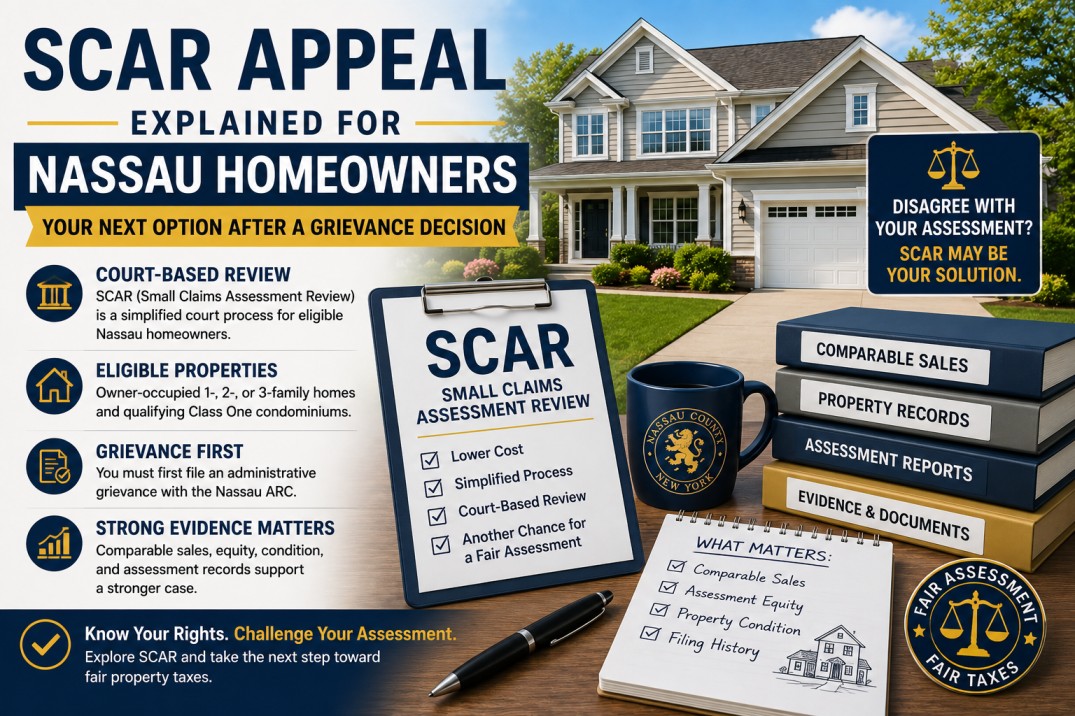
SCAR is a court-based review option available to certain Nassau County homeowners who first filed an administrative property tax grievance.
SCAR stands for:
Small Claims Assessment Review
It is designed to provide eligible homeowners with a lower-cost and more simplified judicial review process compared with formal tax certiorari litigation.
SCAR generally becomes relevant after:
- ARC denies the grievance;
- the reduction is too small;
- major assessment inequities remain unresolved.
SCAR is not the first step.
Homeowners must generally file the administrative grievance process first before pursuing SCAR.
What SCAR Means
SCAR is part of New York’s property tax review system for eligible residential property owners.
SCAR allows qualifying homeowners to challenge property assessments through a court-supervised review process without entering full-scale commercial tax litigation.
The process is intended to be:
- less formal;
- lower cost;
- more accessible for homeowners;
- focused on residential assessment disputes.
However, even though SCAR is simplified compared with formal litigation, it still requires preparation, documentation, and evidence.
Who May Be Eligible
Eligibility rules matter.
In general, SCAR is intended for owner-occupied residential properties, including:
- one-family homes;
- two-family homes;
- three-family homes;
- qualifying Class One condominiums.
Typical Eligibility Factors
| Requirement | Why It Matters |
|---|---|
| Owner occupancy | SCAR is primarily for homeowners, not large investors |
| Residential classification | Commercial properties usually follow different procedures |
| Prior grievance filing | Administrative review must generally happen first |
| Filing deadlines | Missing deadlines may eliminate eligibility |
Property classification and occupancy status can materially affect eligibility.
Why Administrative Grievance Comes First
Before pursuing SCAR, homeowners generally must first file a written complaint through the normal administrative grievance process with Nassau County’s Assessment Review Commission (ARC).
This requirement exists because SCAR functions as a review of the assessment process after administrative remedies have been used first.
In practical terms:
| Stage | Purpose |
|---|---|
| ARC grievance | Administrative review |
| SCAR | Judicial review after ARC process |
Skipping the grievance filing stage can prevent a homeowner from pursuing SCAR later.
This is why filing deadlines and recordkeeping matter even for homeowners who may eventually pursue further review.
How SCAR Differs From ARC Review
ARC review and SCAR review are not the same process.
ARC Review
ARC review is administrative.
The county reviews:
- assessment records;
- comparable properties;
- submitted evidence;
- property characteristics;
- assessment equity arguments.
Most homeowners do not appear in person during standard ARC review.
SCAR Review
SCAR introduces judicial oversight.
The process may involve:
- scheduled hearings;
- evidence presentation;
- assessment analysis;
- comparable property review;
- testimony or explanations;
- judicial determination.
The environment is still simpler than formal litigation, but it is more structured than the ARC administrative process.
ARC vs SCAR Comparison
| Topic | ARC Review | SCAR Review |
|---|---|---|
| Type | Administrative | Court-based |
| Filing Stage | First step | After grievance review |
| Formality | Lower | Higher |
| Hearings | Usually none | May involve hearing |
| Evidence Review | Administrative review | Judicial review |
| Legal Representation | Optional | Sometimes more useful |
| Complexity | Moderate | Higher |
SCAR does not automatically guarantee a better outcome than ARC.
The strength of the evidence still matters most.
What Evidence Matters
Strong SCAR cases are usually evidence-driven.
Important evidence may include:
- comparable sales;
- comparable assessments;
- neighborhood equity analysis;
- property condition documentation;
- appraisal reports;
- contractor estimates;
- photographs;
- inspection reports;
- ARC filing records and determinations.
Comparable Sales and Equity Evidence
Comparable property evidence remains central.
Homeowners often compare:
- similar homes on nearby streets;
- similar building sizes;
- similar lot characteristics;
- similar styles and ages;
- similar condition levels.
The goal is to determine whether the assessment is:
- above market value;
- unequal relative to similar nearby properties;
- unsupported by available data.
Property Condition Evidence
Condition evidence may become especially important when the property has:
- deferred maintenance;
- structural deterioration;
- outdated systems;
- roof issues;
- water damage;
- foundation problems;
- major repair needs.
Examples of Useful Documents
| Evidence Type | Example |
|---|---|
| Inspection report | Structural defects |
| Contractor estimate | Roof replacement |
| Photos | Water damage or deterioration |
| Repair invoices | Major corrective work |
| Appraisal | Condition-adjusted valuation |
Well-documented condition issues can materially affect value conclusions.
Filing Records Matter Too
Homeowners should preserve:
- ARC filing confirmation;
- grievance submissions;
- comparable property analysis;
- ARC determination notices;
- evidence packages;
- correspondence records.
These documents help establish the procedural history of the case.
When to Consider Professional Help
Some homeowners handle SCAR independently.
Others seek professional assistance depending on:
- complexity of the property;
- size of potential savings;
- strength of evidence;
- prior denial history;
- valuation disputes;
- procedural concerns.
Professional assistance may become more valuable when:
| Situation | Why Help May Matter |
|---|---|
| Large assessment differences | Financial stakes increase |
| Complex property characteristics | Valuation analysis becomes harder |
| Prior denial despite strong evidence | Strategy may need refinement |
| Extensive comparable analysis required | Evidence preparation becomes technical |
| Significant condition adjustments | Documentation must be organized carefully |
The decision depends on the homeowner’s comfort level, evidence quality, and financial exposure.
Common Misunderstandings About SCAR
| Misunderstanding | Reality |
|---|---|
| “SCAR is automatic after denial” | Homeowners must still file separately |
| “SCAR guarantees a reduction” | Evidence quality still controls outcomes |
| “Purchase price alone wins the case” | Comparable equity evidence still matters |
| “SCAR is identical to ARC review” | Judicial review differs from administrative review |
| “Only lawyers can file SCAR” | Some homeowners pursue it independently |
Bottom Line
SCAR is a judicial review option available to certain Nassau County homeowners after completing the administrative grievance process.
For eligible owner-occupied residential properties, SCAR may provide another opportunity to challenge an assessment when:
- ARC denied the grievance;
- the reduction was insufficient;
- strong evidence still supports overvaluation or unequal assessment.
However, SCAR is not simply an automatic second review.
Successful cases usually depend on:
- strong comparable evidence;
- organized documentation;
- accurate property analysis;
- careful procedural compliance.
Homeowners considering SCAR should preserve all grievance records and evaluate the strength of their evidence before moving forward.