Table of Contents
- What Should You Review Before Filing?
- 1. Confirm the Correct Assessment Cycle
- 2. Review the County’s Implied Market Value
- 3. Gather Comparable Sales
- 4. Check Nearby Assessment Equity
- 5. Document Property Condition
- 6. Decide Whether to File DIY or Use Support
- 7. Prepare Final ARC Filing Information
- 8. Save Your Confirmation and Records
- Final Takeaway
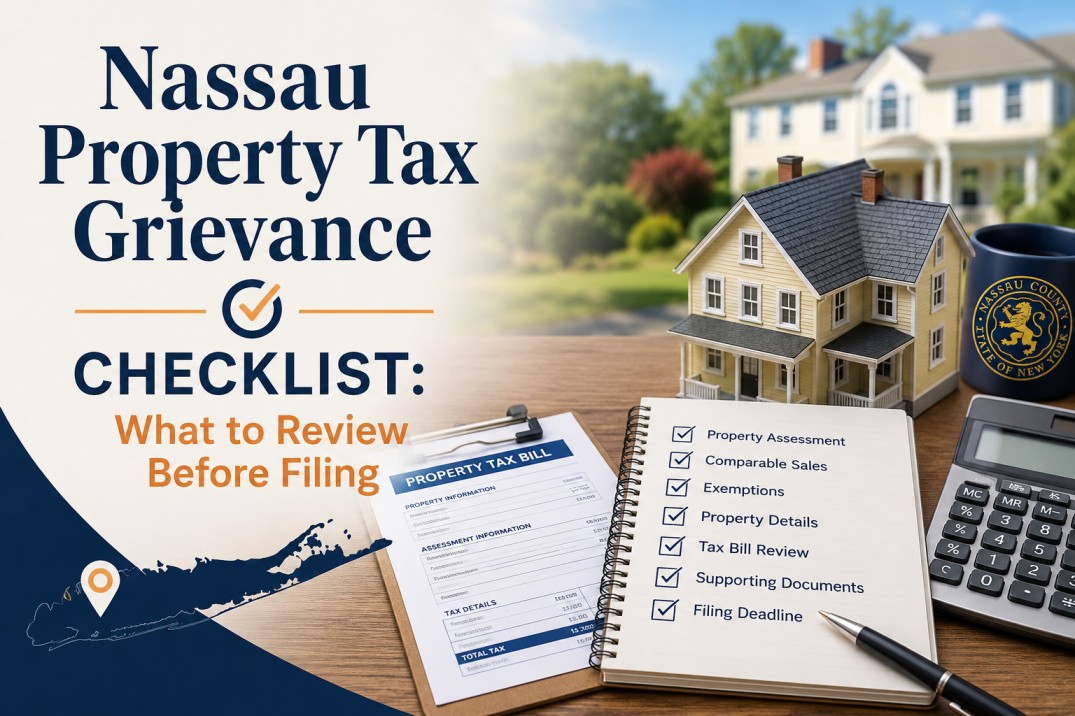
Before you submit a Nassau County property tax grievance, review more than the filing form. A stronger filing connects the County’s assessment to clear evidence: the correct assessment cycle, comparable sales, nearby assessment patterns, property condition, and accurate parcel information.
This checklist is designed for Nassau County homeowners preparing an Assessment Review Commission (ARC) grievance. Use it to organize your review before deciding whether to file yourself, purchase a DIY Evidence Pack, or use full-service grievance support.
What Should You Review Before Filing?
Before filing a Nassau property tax grievance, homeowners should review:
- The correct assessment cycle and filing deadline;
- The County’s implied market value;
- Recent comparable sales;
- Similar nearby assessments;
- Property condition and defects;
- Owner and parcel information;
- Supporting documents;
- Filing confirmation records.
The goal is not simply to say your taxes are too high. The goal is to show why the County’s assessed value may be higher than the evidence supports.
1. Confirm the Correct Assessment Cycle
Nassau County grievances are tied to the tentative assessment roll, not simply the tax bill you are paying today.
Before filing, confirm:
- The assessment year being challenged;
- The tax year affected by that assessment;
- The current ARC filing deadline;
- Whether the filing window is still open.
Only the current tentative assessment roll can generally be challenged through the annual grievance process. Prior-year assessments are usually not handled through the current filing cycle.
Checklist
- I confirmed the current tentative assessment roll.
- I confirmed the filing year and affected tax year.
- I checked the current ARC deadline.
- I understand that missing the deadline may mean waiting for the next cycle.
2. Review the County’s Implied Market Value
Nassau’s assessed value is much smaller than the property’s market value because of the residential level of assessment.
For example, if the residential level of assessment is 0.1%, an assessed value of $850 implies a market value of approximately $850,000 ($\text{Assessed Value} \div 0.001 = \text{Implied Market Value}$).
The important question is: Does the County’s implied market value appear supported by recent comparable sales and similar nearby properties? Do not rely only on a gut feeling. Compare the County’s value against evidence.
Checklist
- I found my current assessed value.
- I converted it into an implied market value.
- I compared that value against recent nearby sales.
- I checked whether the County’s value appears too high.
3. Gather Comparable Sales
Comparable sales help test whether the County’s market value is reasonable. Good comparable sales are usually:
- Recent (typically within the past year);
- Nearby (on your immediate block or neighborhood grid);
- Similar in property class, building type, style, and age;
- Matching in physical metrics like Gross Living Area (GLA) and lot size;
- Located within an identical school-district or municipal context.
Same-block or same-street sales can be especially useful, but they are not automatically better if the properties are structurally or qualitatively different.
Checklist
- I collected recent sales near my property.
- I removed sales that are too old or too different.
- I compared living area, lot size, age, condition, and style.
- I noted any major differences that require explanation.
4. Check Nearby Assessment Equity
A property may also appear over-assessed if similar nearby homes carry lower assessments. This is different from comparable sales. Comparable sales look at market transactions, while assessment equity looks at how similar properties are assessed relative to each other on the county roll.
Review homes that are highly similar in:
- Geographic location (same Section-Block-Lot boundary networks);
- Property class and building type;
- Gross Living Area (GLA) and lot size;
- Structural grade or construction quality parameters;
- Condition, Desirability, and Utility (CDU) rating;
- Year built or renovation baseline.
If several structurally identical nearby homes are assessed more favorably, that data anomaly may help support a structural grievance argument.
Checklist
- I reviewed similar nearby assessments.
- I compared homes with similar physical characteristics.
- I noted properties that appear assessed more favorably.
- I recorded the parcel/SBL information for relevant comparison properties.
5. Document Property Condition
If your home has deferred maintenance or structural defects, those facts may support a lower valuation baseline compared with fully renovated peer properties. Useful condition evidence may include:
- Dated photographs showing defects;
- Itemized contractor repair estimates;
- Professional home inspection reports;
- Repair invoices and receipts;
- Documentation covering roof, foundation, water, electrical, plumbing, or structural damage;
- Notes showing whether a defect existed before the taxable-status date.
Examples of Relevant Issues:
- Aging or failing roof;
- Water infiltration, mold, or foundation concerns;
- Outdated major HVAC, plumbing, or electrical systems;
- Unpermitted or completely unusable areas;
- Functional layout deficiencies;
- Severe interior or exterior structural damage not reflected in County records.
Condition evidence is strongest when it is specific, objectively documented, and cleanly connected to an estimated cost-to-cure.
Checklist
- I photographed visible condition issues.
- I saved contractor estimates or repair records.
- I separated cosmetic issues from major value-impacting defects.
- I checked whether County records overstate the condition of the property.
6. Decide Whether to File DIY or Use Support
Before filing, evaluate the complexity of your property's profile and decide how much data support you require.
| Filing Path | When It May Fit |
|---|---|
| DIY Filing | You are fully comfortable navigating County systems and preparing your own evidence documents manually. |
| DIY Evidence Pack | You prefer to control and file the appeal yourself but require organized, forensic comparable sales and assessment analysis. |
| Full-Service Support | The case has higher estimated savings, complex structural evidence, or you want professional help managing the administrative process. |
Nassau homeowners do not necessarily need a lawyer to file a grievance. The real question is whether you have the time, confidence, and precise evidence to prepare the filing properly.
Checklist
- I understand the filing process.
- I know whether I want to file myself or use support.
- I have enough evidence to explain the requested reduction.
- I understand the cost of any paid support before choosing it.
7. Prepare Final ARC Filing Information
Before hitting submit, make sure the administrative and legal parcel information is completely accurate. Review:
- Owner name (matching the property deed exactly);
- Complete property situs address;
- Section, Block, and Lot (SBL) identifiers;
- Intended assessment year;
- Contact details;
- Evidence attachment files;
- Requested assessment value, if required;
- Signed authorization documents (if an outside entity is representing you).
Incorrect or incomplete parcel metadata can delay administrative review or weaken the legal standing of the filing.
Checklist
- Owner name matches the official property record.
- Property address is verified and correct.
- Section, Block, and Lot (SBL) are accurate.
- Evidence files are legible, organized, and clearly labeled.
- I saved digital copies of all materials before submission.
8. Save Your Confirmation and Records
After filing, secure a complete physical or digital copy of your submission package. Save:
- The official digital confirmation number;
- The exact submitted petition form;
- The complete evidence brief or packet;
- Email receipts and timestamps;
- Screenshots or saved PDFs of confirmation pages;
- Certified mailing receipts (if filing via paper copy);
- Any subsequent ARC correspondence;
- The final determination notice.
If the grievance is initially denied or the reduction is lower than expected, these records are essential when reviewing possible next steps, including an escalation to the Small Claims Assessment Review (SCAR), if eligible.
Checklist
- I saved the official filing confirmation number.
- I saved a full copy of the submitted evidence packet.
- I saved all ongoing ARC correspondence.
- I know where to find the records if I need them later.
Final Takeaway
A strong Nassau property tax grievance is not just a form. It is a structured review of the County’s assessment, recent comparable sales, nearby assessment equity, property condition, and filing-cycle details. Before you file, make sure your evidence is organized, your parcel information is correct, and your filing path matches the complexity of your case.