Table of Contents
- Start With the Number You Actually Have: The Original Tentative Assessment
- Why the Department's Market Value Is Not the Whole Story
- What Is the Adjusted Tentative Assessment?
- Why You Usually Do Not Know the Adjusted Tentative When You File
- Why ARC's LOA Can Be Different From the Department's 0.1%
- A Real Example: Why the Numbers Look So Different
- Which Value Should You Compare With Comparable Sales?
- What Should You Use When Filing a New-Year Grievance?
- What Evidence Should Support the Filing?
- Comparable Sales: Evidence of Market Value
- Assessment Equity Analysis: Supplemental Evidence
- Is Unequal Assessment a Valid Basis for Appeal?
- How to Convert Your Market Value Estimate Into an Assessment
- What Changes When ARC Sends an Offer?
- How to Evaluate an ARC Offer
- Filing Analysis and Offer Analysis Are Different
- A Simple Summary
- The Bottom Line
Nassau County property tax grievances can be confusing for a simple reason: the same property can appear to have several different “values” at different stages of the process.
A homeowner may see:
- a Full Market Value on the Department of Assessment website,
- an Original Tentative Assessment on the tentative roll,
- an Adjusted Tentative Assessment later in an ARC offer,
- a Reduced Assessment proposed by ARC,
- and a different Level of Assessment (LOA) used by ARC than the one used by the Department of Assessment. All of those numbers can be legitimate at the same time.
The key is understanding what each number is for — and, just as importantly, which number you should use at each stage of a grievance.
This article walks through the process from the moment the tentative roll is published through the point when ARC sends a settlement offer.
Start With the Number You Actually Have: The Original Tentative Assessment
At the beginning of a new grievance year, the most important number is the Original Tentative Assessment.
This is the assessment initially placed on the tentative roll by the Nassau County Department of Assessment.
For Class 1 residential property, the Department currently expresses assessments using a 0.1% Level of Assessment.
That means:
Assessed Value = Full Market Value × 0.1%
So if the Department shows:
Full Market Value: $873,000
then the tentative assessment would be:
$873,000 × 0.001 = 873
In that situation:
- Department Full Market Value = $873,000
- Original Tentative Assessment = 873
This is the starting point for the new year's grievance.
At the time you file, this may be the only official assessment baseline available.
Why the Department's Market Value Is Not the Whole Story
A common mistake is to look at the Department's published market value and ask only:
“Is my home worth more or less than this number?”
That is useful, but it does not tell the entire story.
The Department's market value is tied to the Department's own 0.1% assessment methodology.
ARC, however, may later use a different Level of Assessment when resolving Class 1 grievances.
That means the same assessment number can correspond to a very different market-value equivalent under ARC's settlement methodology.
This is one of the most important things for Nassau County homeowners to understand.
What Is the Adjusted Tentative Assessment?
The Adjusted Tentative Assessment usually does not appear when the new tentative roll is first published.
It may appear later, when ARC sends a settlement offer.
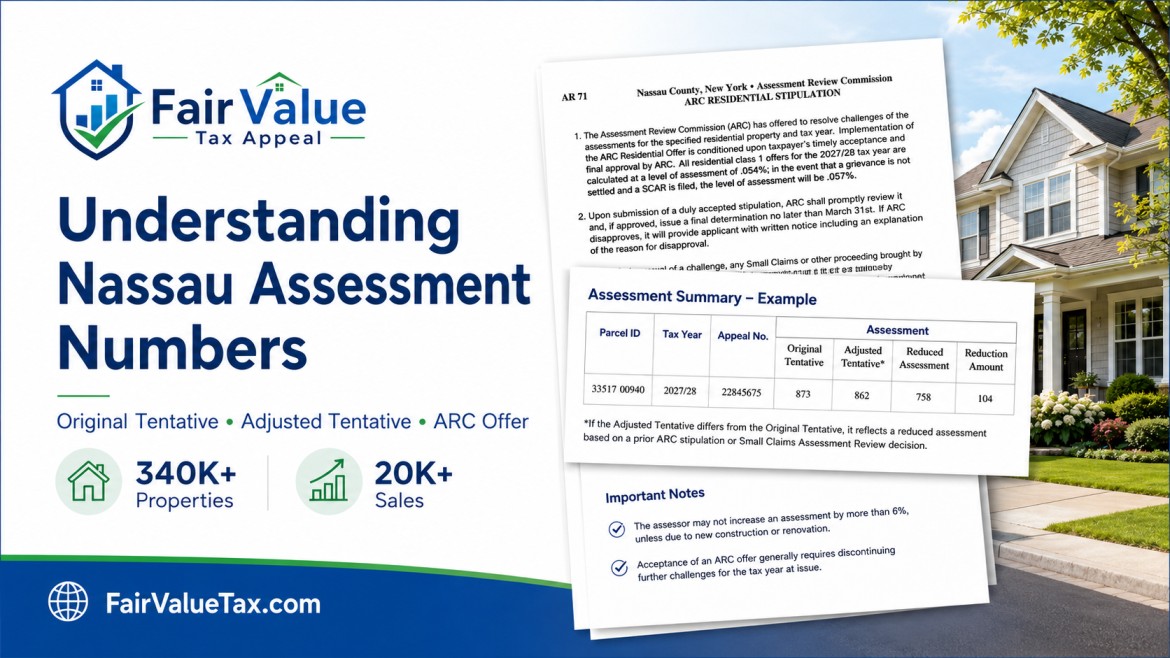
ARC explains that when the Adjusted Tentative differs from the Original Tentative, the difference reflects a prior ARC stipulation or Small Claims Assessment Review decision.
That can matter because Class 1 assessments are generally subject to statutory limits on annual increases.
Under New York Real Property Tax Law §1805, Class 1 assessments are generally limited to increases of no more than:
- 6% in one year, and
- 20% over five years
subject to certain exceptions, including new construction and renovations.
So imagine that the Department publishes:
Original Tentative Assessment: 873
but ARC later shows:
Adjusted Tentative Assessment: 862
The lower number may reflect the effect of a prior successful grievance or SCAR decision combined with the applicable assessment cap.
For the current grievance, ARC may treat 862, not 873, as the effective starting assessment when calculating the reduction.
Why You Usually Do Not Know the Adjusted Tentative When You File
This timing issue is important.
When the new tentative roll is published, homeowners generally know:
- the new Original Tentative Assessment,
- the Department's published market value,
- the Department's current LOA.
But they may not yet know:
- whether ARC will later calculate a different Adjusted Tentative Assessment,
- what ARC's new Level of Assessment will be for that grievance year.
That means an early grievance analysis has to work with the information available at the time.
For a new filing year, the practical approach is:
Use the new Original Tentative Assessment as the official starting assessment.
If the current year's ARC LOA has not yet been released, the most recent prior-year ARC LOA can be used as an estimate for analysis, but it should be clearly identified as provisional.
Once ARC publishes or states the new year's LOA, the analysis should be updated.
Why ARC's LOA Can Be Different From the Department's 0.1%
This is often the most confusing part.
The Department of Assessment may publish Class 1 assessments using:
0.1%
while ARC may later resolve grievances using a lower LOA.
For example, for the 2027/28 tax year, ARC's residential stipulation states that Class 1 settlement offers are calculated using:
ARC LOA: 0.054%
and, if the matter proceeds to SCAR:
SCAR LOA: 0.057%
These are not simply alternative ways of displaying the same number.
They are used at different stages of the assessment-review process.
The Department's 0.1% LOA is used to publish the tentative assessment roll.
ARC's LOA is used when ARC evaluates and resolves Class 1 grievances for that year.
That difference has a major practical consequence:
The Department's displayed market value may be much lower than the market value implied by the same assessment under ARC's LOA.
A Real Example: Why the Numbers Look So Different
Consider this ARC-style example:
| Assessment Stage | Amount |
|---|---|
| Original Tentative | 873 |
| Adjusted Tentative | 862 |
| Reduced Assessment | 758 |
| Reduction Amount | 104 |
Using the Department's 0.1% LOA:
873 ÷ 0.001 = $873,000
So the Department's published market value may be approximately:
$873,000
But now look at the same property using ARC's 0.054% LOA.
The Adjusted Tentative Assessment of 862 corresponds to:
862 ÷ 0.00054 ≈ $1,596,296
And ARC's proposed Reduced Assessment of 758 corresponds to:
758 ÷ 0.00054 ≈ $1,403,704
So the homeowner may simultaneously see:
- Department Full Market Value: about $873,000
- ARC-equivalent starting value: about $1.60 million
- ARC-offer equivalent value: about $1.40 million
At first glance, those numbers look inconsistent.
They are not.
They are based on different Levels of Assessment used for different purposes.
Which Value Should You Compare With Comparable Sales?
This is the practical question that matters most when preparing a grievance.
Suppose good comparable sales indicate that your property was worth around:
$1,250,000
A homeowner might look at the Department website, see a market value of:
$873,000
and think:
“My house is worth more than Nassau County says. I must not have a grievance.”
But that conclusion can be misleading.
If ARC's applicable LOA is 0.054%, an assessment of 862 corresponds to an ARC-equivalent market value of about:
$1.60 million
So comparable-sale evidence supporting $1.25 million may still support a lower assessment.
For grievance analysis, the more meaningful comparison is often:
Evidence-Supported Market Value
versus
Assessment ÷ Applicable ARC LOA
rather than simply:
Evidence-Supported Market Value
versus
Department Full Market Value
That distinction is critical.
What Should You Use When Filing a New-Year Grievance?
At filing time, you often do not yet have the final ARC inputs.
So the analysis should be divided into what is known and what is estimated.
What is known
You generally have:
- the new Original Tentative Assessment,
- the Department's Full Market Value,
- the Department's published LOA,
- your property's characteristics,
- recent comparable sales,
- prior assessment and grievance history.
What may still be unknown
You may not yet have:
- the new year's ARC LOA,
- the new year's Adjusted Tentative Assessment,
- ARC's eventual settlement offer.
So the filing-stage analysis should be framed as:
Current official assessment + current market evidence + provisional ARC benchmark
not as though all future ARC numbers are already known.
For example:
Original Tentative Assessment: 900
Prior-year ARC LOA: 0.054%
Estimated ARC-equivalent value:
900 ÷ 0.00054 ≈ $1.67 million
If comparable sales support a value of only $1.30 million, that difference may indicate a meaningful grievance opportunity.
But the 0.054% figure should be labeled as an estimate until the current year's ARC LOA is known.
What Evidence Should Support the Filing?
A strong grievance should not rely on a single number.
There are two different types of evidence that can be useful.
Comparable Sales: Evidence of Market Value
Comparable sales are the most direct way to support a claimed full market value.
The strongest comparables usually have similar:
- location,
- school district,
- property type,
- living area,
- lot size,
- age,
- style,
- condition,
- major improvements.
Recent arm's-length sales of truly similar homes help answer:
“What would this property reasonably have sold for as of the relevant valuation date?”
That is a core valuation question.
Assessment Equity Analysis: Supplemental Evidence
Homeowners also often notice that similar houses have lower assessments.
That observation can be useful, but it needs to be handled carefully.
A lower assessment on one nearby property does not automatically prove that your assessment is wrong.
Different properties may have different:
- prior grievance histories,
- prior SCAR outcomes,
- assessment caps,
- improvements,
- condition,
- physical characteristics.
However, if a broader group of highly similar properties consistently shows lower assessment levels, that can still be useful supplemental evidence.
A careful equity analysis should therefore focus on truly comparable properties rather than simply neighboring homes.
For example, it may compare houses with similar:
- style,
- square footage,
- lot size,
- grade,
- condition,
- age,
- school district,
- and other relevant physical characteristics.
That kind of analysis can help identify whether the subject appears unusually assessed relative to its closest peers.
But it should generally support — not replace — a market-value analysis based on comparable sales.
Is Unequal Assessment a Valid Basis for Appeal?
Yes.
Unequal assessment is a recognized basis for challenging a property assessment.
But there is an important distinction between:
an unequal-assessment claim
and
simply pointing to one neighbor with a lower assessment.
An unequal-assessment claim concerns whether the subject property is being assessed at an appropriate level relative to the applicable class.
That is broader than saying:
“My neighbor's assessment is lower than mine.”
So a well-prepared grievance can include both:
Comparable-sale evidence
to support a claimed market value,
and
carefully selected peer-assessment evidence
to show that the subject may also be an assessment outlier among similar properties.
The two types of evidence answer different questions.
How to Convert Your Market Value Estimate Into an Assessment
Suppose your comparable-sales analysis supports a market value of:
$1,250,000
If you are using an estimated ARC LOA of 0.054% for planning purposes:
$1,250,000 × 0.00054 = 675
That suggests an assessment around:
675
Now compare that with an Original Tentative Assessment of:
900
The difference is substantial.
That does not mean ARC will necessarily agree with 675.
But it gives the homeowner a rational way to connect market-value evidence to the assessment being challenged.
What Changes When ARC Sends an Offer?
Once ARC issues a settlement offer, the analysis becomes much more precise.
At that point, ARC may provide:
- Original Tentative Assessment,
- Adjusted Tentative Assessment,
- Reduced Assessment,
- Reduction Amount,
- the actual ARC LOA for that assessment year.
Now you no longer need to rely on the prior year's LOA as an estimate.
You can use the official current-year ARC LOA.
This is where the grievance moves from:
estimated opportunity analysis
to
actual settlement evaluation.
How to Evaluate an ARC Offer
Suppose ARC sends:
| Assessment Stage | Amount |
|---|---|
| Original Tentative | 873 |
| Adjusted Tentative | 862 |
| ARC Offer | 758 |
and states that the applicable ARC LOA is:
0.054%
Then:
Adjusted Tentative ARC-equivalent value
= 862 ÷ 0.00054 ≈ $1.60 million
ARC Offer equivalent value
= 758 ÷ 0.00054 ≈ $1.40 million
Now compare that $1.40 million offer with your independent market-value evidence.
If your comparable-sales analysis supports:
$1.35 million
the offer may be fairly close to your evidence.
If your comparables support:
$1.10 million
there may be a larger remaining gap.
This is a much more useful way to evaluate an ARC offer than looking only at the percentage reduction.
Filing Analysis and Offer Analysis Are Different
This distinction is worth remembering.
When you file
You are working with:
- Original Tentative Assessment,
- current comparable sales,
- historical assessment information,
- prior-year ARC LOA as a provisional estimate if needed.
The question is:
Does the evidence suggest that the assessment should be challenged?
When ARC sends an offer
You now have:
- Adjusted Tentative Assessment,
- official current-year ARC LOA,
- ARC Reduced Assessment.
The question becomes:
Does ARC's proposed assessment reasonably reflect the property's supported market value?
Those are different stages and should be analyzed differently.
A Simple Summary
If all of these terms feel confusing, think of them this way.
Original Tentative Assessment
The assessment initially published for the new year.
This is the number you know when the grievance period begins.
Adjusted Tentative Assessment
A later effective baseline that may reflect a prior ARC or SCAR reduction and statutory assessment limits.
You may not know this number when you first file.
Department LOA
The Level of Assessment used by the Department of Assessment to publish the assessment roll.
For Class 1, this has been 0.1%.
ARC LOA
The Level of Assessment ARC uses to calculate settlement offers for a particular grievance year.
This can differ substantially from the Department's LOA and can change from year to year.
ARC-Equivalent Market Value
A useful analytical concept:
Assessment ÷ ARC LOA
It shows the market value implied by an assessment under ARC's methodology.
This is especially useful when comparing an assessment or settlement offer with comparable-sale evidence.
The Bottom Line
There is no single Nassau County number that tells the whole story.
When a new grievance year begins, the Original Tentative Assessment is the official number you are challenging.
At that stage, the new Adjusted Tentative Assessment and new ARC LOA may not yet be available.
So a reasonable early analysis uses:
the new Original Tentative Assessment, current comparable-sales evidence, and the most recent ARC LOA only as a clearly labeled estimate where necessary.
Later, when ARC issues a settlement offer, the picture becomes clearer.
You can replace those estimates with:
- the actual Adjusted Tentative Assessment,
- the current year's ARC LOA,
- and ARC's proposed Reduced Assessment.
From there, the most important question is not simply:
“How much did ARC reduce my assessment?”
It is:
“What market value does ARC's offer imply, and is that value supported by the best available evidence?”
That is the question homeowners should ultimately be trying to answer.
Review Your Nassau County Assessment
FairValue analyzes Nassau County assessment history, comparable sales, property characteristics, prior grievance outcomes, and peer-assessment patterns to help homeowners understand whether an assessment may warrant a challenge.
For homeowners represented by FairValue, ARC will notify FairValue when a settlement offer is issued.
At that point, the analysis can be updated using the official current-year information shown in the offer, which may include:
Original Tentative Assessment, Adjusted Tentative Assessment, Reduced Assessment, Reduction Amount, and the current-year ARC Level of Assessment.
This replaces the provisional assumptions used earlier in the filing cycle.
FairValue can then evaluate the offer against the property's comparable-sale evidence, assessment history, and other relevant valuation data and provide guidance on whether the offer appears reasonable to accept or whether further review may be justified.
Enter your property address at fairvaluetax.com to review your assessment and supporting evidence.
Levels of Assessment can change from year to year. Any prior-year ARC LOA used before the current year's official rate is released should be treated as an estimate. This article is for educational purposes and is not legal advice.