Table of Contents
- What “Cost to Cure” Means
- Complaints Fail. Documentation Works.
- The Right Valuation Logic
- Example: Turning a Roof Problem Into Appeal Evidence
- Use the Right Category of Evidence
- What a Strong Cost-to-Cure Package Includes
- Cost-to-Cure Works Best With Comparable Analysis
- What Cost-to-Cure Is Not
- The Strategic Value of a Cost-to-Cure Argument
- Final Takeaway
- 💡 Trivia Time: Why Repair Estimates Matter
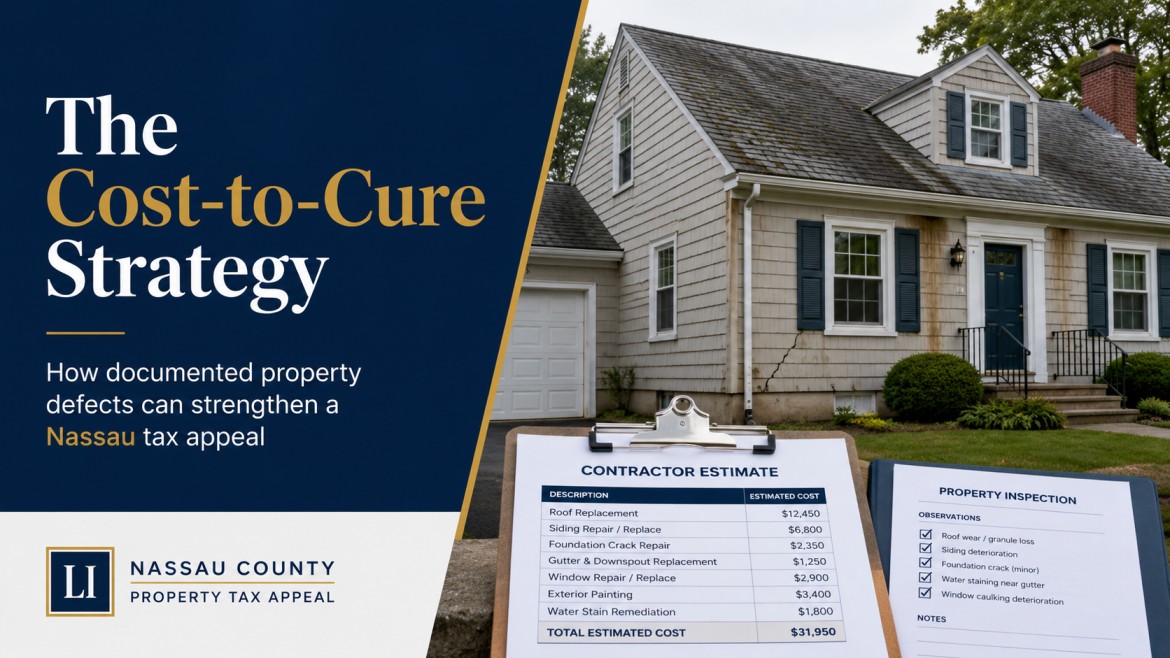
A Nassau County property tax appeal is stronger when it translates property defects into objective valuation evidence.
Saying:
My house is old”
“The roof is bad”
“The basement has cracks
is not enough.
A better argument is:
The property has a documented condition issue that would affect what a buyer is willing to pay, and the cost to address it can be quantified.
That is the logic behind a cost-to-cure strategy.
What “Cost to Cure” Means
Cost to cure is the estimated expense required to remedy a material property defect.
| Property Defect | Supporting Evidence |
|---|---|
| Failing roof | Contractor estimate, photos |
| Foundation or masonry cracks | Repair proposal, condition photos |
| Water intrusion | Waterproofing quote, remediation scope |
| Deteriorated exterior components | Contractor documentation |
| Major mechanical replacement need | Written estimate |
A repair estimate does not automatically create a dollar-for-dollar assessment reduction. Instead, it helps support a lower value argument by showing that the property carries a real, measurable condition burden.
Complaints Fail. Documentation Works.
| Weak Claim | Stronger Appeal Framing |
|---|---|
| “My house needs work.” | “The property has documented deferred maintenance supported by photographs and contractor estimates.” |
| “The roof is old.” | “The roof requires replacement, with an estimated cost of $18,000.” |
| “My neighbor’s house is better.” | “The subject property has material defects not reflected in the county baseline or peer comparison.” |
The difference is precision.
ARC does not need emotion. It needs organized evidence.
The Right Valuation Logic
A cost-to-cure argument should follow a clear sequence:
| Step | Question |
|---|---|
| 1. Identify the defect | What condition exists? |
| 2. Document it | Are there photographs or written findings? |
| 3. Quantify the cure | What does repair or replacement cost? |
| 4. Tie it to value | Would a buyer discount the property because of it? |
| 5. Integrate it into the appeal | Does it support a lower assessment conclusion? |
This is the difference between a homeowner complaint and a baseline verification argument.
Example: Turning a Roof Problem Into Appeal Evidence
Property Condition
- 25-year-old roof
- Visible interior staining
- Replacement recommended
- Contractor estimate: $18,000
Weak Version
The roof is old, so my assessment should be lower.
Stronger Version
The subject property has a materially deteriorated roof system requiring replacement. The condition is supported by photographs and a contractor estimate of approximately $18,000. This near-term capital expenditure may affect what a rational buyer would pay and should be considered when reviewing the property’s value.
That wording is more useful because it connects:
- the defect,
- the repair cost,
- and the market-value impact.
Use the Right Category of Evidence
For most residential defects, the strongest framing is usually:
- physical deterioration,
- deferred maintenance,
- or condition-based value impairment.
Not every defect should be labeled “functional obsolescence.”
| Issue | Better Framing |
|---|---|
| Roof failure | Physical deterioration |
| Water intrusion | Deferred maintenance / condition impairment |
| Structural cracking | Physical deterioration |
| Poor or obsolete layout | Possible functional obsolescence |
Precision matters. Overstating the concept weakens the appeal narrative.
What a Strong Cost-to-Cure Package Includes
| Evidence Item | Purpose |
|---|---|
| Photos | Show the condition |
| Contractor estimate | Quantify repair cost |
| Scope of work | Clarify what must be addressed |
| Property comparison | Show why the defect matters relative to peers |
| Appeal narrative | Connect the evidence to value |
The goal is not to submit a pile of documents. The goal is to present a coherent condition-based valuation argument.
Cost-to-Cure Works Best With Comparable Analysis
A repair estimate becomes more persuasive when paired with peer comparison.
| Comparison Factor | Subject Property | Comparable Peer |
|---|---|---|
| Style | Colonial | Colonial |
| Size | Similar | Similar |
| Location | Same or nearby Nassau area | Same or nearby Nassau area |
| County baseline | Similar or higher | Similar or lower |
| Documented defects | Roof, water intrusion | None identified |
This supports a sharper point:
The subject property should not be valued as though it is in the same condition as cleaner peer properties.
What Cost-to-Cure Is Not
| Misconception | More Accurate View |
|---|---|
| Every repair lowers assessment | Only material, value-relevant issues matter |
| $18,000 quote = $18,000 reduction | The quote supports a value argument; it is not automatic |
| Cosmetic updates are enough | Major condition issues are more persuasive |
| Defect evidence replaces comparables | It is strongest when combined with broader valuation support |
The Strategic Value of a Cost-to-Cure Argument
For Nassau County Class 1 residential property owners, the appeal should move from:
My home has problems.
to:
The county’s valuation should be reviewed because the subject property carries documented condition impairments with measurable cost-to-cure implications.
FairValue AI can incorporate:
- contractor estimates,
- property defect descriptions,
- condition evidence,
- and Nassau peer comparisons
into a precision-targeted appeal narrative.
This creates a stronger, more systematic argument than generic statements about deferred maintenance.
Final Takeaway
Property defects do not help an appeal simply because they exist.
They help when they are:
- material,
- documented,
- quantified,
- and connected to market value.
That is the cost-to-cure strategy.
Scan your property at fairvaluetax.com to begin your baseline verification and build a more data-driven Nassau County assessment appeal.
💡 Trivia Time: Why Repair Estimates Matter
A contractor estimate does not decide the value of a home by itself. Its role is to translate a visible defect into an objective cost burden that can be incorporated into a valuation argument.
That is why a written repair estimate is typically far more useful than a general statement that a house “needs work.”