Table of Contents
- Direct Answer: Which Filing Path Fits Your Property?
- What a DIY Nassau Grievance Actually Means
- What Full-Service Representation Means
- The Real Financial Comparison
- When DIY Filing Is Usually the Best Strategy
- When Full-Service Support Is Worth the Cost
- The Core Decision Matrix
- The Emerging Hybrid Model
- Common Misconceptions About DIY Filing
- Final Takeaway
Every year, Nassau County homeowners face the same decision during the Assessment Review Commission (ARC) filing season:
Should I file my property tax grievance myself, or hire a professional representative?
Historically, the choice was highly polarized:
- Spend hours manually researching comparable properties and county records; or
- Surrender 40%–50% of your future tax savings to a contingency-based grievance firm.
Today, automated property analytics have changed the equation.
For many homeowners, the decision is no longer emotional — it is operational and financial.
The correct filing path depends on:
- Property complexity;
- Time availability;
- Evidence quality;
- Target net savings;
- Whether escalation to SCAR is likely.
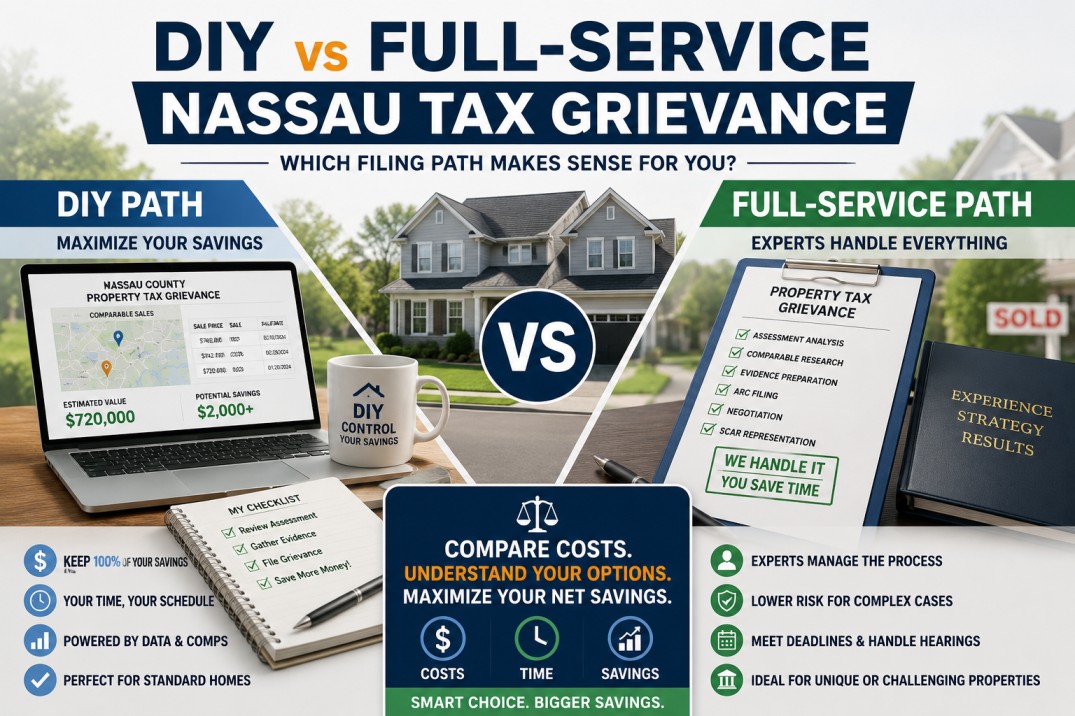
Direct Answer: Which Filing Path Fits Your Property?
In simple terms:
DIY Filing Makes Sense If:
- Your property is a standard residential home;
- Comparable sales are easy to identify;
- County records are mostly accurate;
- You want to maximize net savings;
- You are comfortable submitting documents online.
A properly prepared DIY filing allows you to keep 100% of your tax reduction.
Full-Service Filing Makes Sense If:
- The property has unusual characteristics;
- Major condition issues exist;
- Ownership structure is complex;
- You may need SCAR escalation;
- You want a completely hands-off process.
In these cases, professional management can reduce administrative and evidentiary risk.
What a DIY Nassau Grievance Actually Means
A DIY grievance means you act as your own representative before ARC.
You are responsible for:
- Reviewing the tentative assessment;
- Verifying county property data;
- Uploading evidence;
- Filing within the deadline.
However, modern DIY filing is no longer purely manual.
The key difference today is automation.
Instead of spending days pulling scattered public records, homeowners can now use automated evidence-generation systems to produce:
- Comparable sales analysis;
- SBL equity comparisons;
- Valuation summaries;
- Filing-ready evidence packets.
The homeowner still submits the filing personally, but the heavy analytical work becomes largely automated.
What Full-Service Representation Means
Full-service representation means authorizing a third-party firm to manage the grievance process from beginning to end.
A representative typically handles:
- Assessment analysis;
- Comparable sales research;
- Evidence preparation;
- ARC submission;
- Settlement review;
- SCAR escalation if necessary.
Most Nassau grievance firms operate on contingency pricing.
That means:
- No upfront payment;
- The firm only gets paid if a reduction is secured;
- The fee is usually 40%–50% of first-year savings.
This structure reduces upfront risk, but substantially reduces the homeowner’s net recovery.
The Real Financial Comparison
The key question is not:
“Can I win?”
The key question is:
“How much of the savings do I actually keep?”
Below is a simplified example using a hypothetical $2,000 annual tax reduction.
| Financial Metric | Manual DIY | DIY Evidence Pack | Traditional Full-Service |
|---|---|---|---|
| Upfront Cost | $0 | Low Flat Fee | $0 |
| Time Investment | 10–20 Hours | ~15 Minutes | Near Zero |
| Contingency Fee | 0% | 0% | 40%–50% |
| Estimated Fee Paid | $0 | Minimal | $800–$1,000 |
| Gross Tax Savings | $2,000 | $2,000 | $2,000 |
| Estimated Net Savings | ~$2,000 | ~$1,900+ | ~$1,000–$1,200 |
The economics become clear quickly:
- Full-service representation reduces effort;
- DIY maximizes retained savings;
- Automated DIY tools increasingly bridge the gap between the two.
When DIY Filing Is Usually the Best Strategy
DIY filing works extremely well under predictable neighborhood conditions.
1. Standard Residential Properties
Examples include:
- Split-level homes;
- Colonials;
- Ranches;
- Capes.
If your block contains many physically similar homes, valuation evidence becomes easier to demonstrate.
2. Clear Comparable Sales Exist
DIY filing is strongest when nearby homes recently sold at prices below the County’s implied valuation.
This creates straightforward evidence.
3. County Records Are Mostly Accurate
If the County already correctly reflects:
- Square footage;
- Bathrooms;
- Lot size;
- Property class;
- Condition;
then the filing process becomes much simpler.
4. You Want Maximum Capital Retention
Many homeowners prefer retaining the full reduction rather than giving away half the savings annually.
This becomes increasingly important as:
- School taxes rise;
- Municipal rates increase;
- Assessment drift compounds over time.
When Full-Service Support Is Worth the Cost
There are situations where professional representation becomes strategically valuable.
1. Severe Property Condition Problems
Examples include:
- Foundation damage;
- Structural settlement;
- Roof failure;
- Water intrusion;
- Fire damage.
These cases often require more sophisticated “cost-to-cure” valuation adjustments and evidence formatting.
2. Unique or Non-Standard Homes
Custom-built homes are harder to value because direct comparable properties may not exist nearby.
Professional manual comp selection becomes more important.
3. Complex Ownership Structures
Examples include:
- LLC ownership;
- Trust ownership;
- Estate transfers;
- Inherited properties.
Administrative filing mistakes can cause immediate rejection if documentation is incomplete.
4. Potential SCAR Escalation
If ARC denies the grievance and the homeowner wishes to continue into Small Claims Assessment Review (SCAR), professional assistance may become more useful.
5. Time Constraints
Some homeowners simply do not want to manage:
- Deadlines;
- Uploads;
- Settlement reviews;
- Administrative tracking.
In those cases, paying for convenience may be rational.
The Core Decision Matrix
Use this simplified framework:
| Factor | DIY Filing | Full-Service |
|---|---|---|
| Property Type | Standard residential | Complex or unique |
| Comparable Sales | Easy to identify | Difficult or sparse |
| County Record Accuracy | Mostly accurate | Significant discrepancies |
| Time Availability | Can spend 15–30 minutes | Wants zero involvement |
| Goal | Maximize net savings | Minimize administrative effort |
| SCAR Probability | Low | Moderate to high |
The Emerging Hybrid Model
A growing number of homeowners now choose a hybrid approach:
- Use automated evidence-generation tools;
- File independently at ARC;
- Only hire professional representation if escalation becomes necessary later.
This model minimizes contingency costs while preserving optionality.
For many Nassau homeowners, this is becoming the most economically efficient structure.
Common Misconceptions About DIY Filing
“DIY Means Weak Evidence”
Not necessarily.
Modern data automation can produce highly structured evidence packets using:
- Comparable sales;
- Assessment equity analysis;
- Neighborhood valuation patterns;
- SBL-based comparisons.
The key is evidence quality — not whether a lawyer clicked the upload button.
“Full-Service Guarantees Better Results”
Not always.
Many firms rely heavily on automated mass-filing systems themselves.
For standard residential properties, the outcome often depends more on the underlying assessment data than on aggressive legal strategy.
“DIY Filing Is Too Complicated”
For straightforward homes, the actual filing process is usually operationally simple once the evidence is prepared.
The hardest part historically was the data gathering — not the submission itself.
Final Takeaway
There is no universally correct filing path.
The best strategy depends on balancing:
- Complexity;
- Time;
- Net savings;
- Administrative tolerance.
For standard Nassau residential properties with clear comparable evidence, DIY filing supported by automated valuation tools can preserve substantially more long-term savings.
For highly complex properties, severe condition issues, or likely SCAR escalation, full-service representation may justify its contingency fee.
The important thing is not choosing the “perfect” method.
The real mistake is allowing an inflated assessment baseline to compound year after year without challenging it.