Table of Contents
- Direct Answer: Can ARC Raise My Assessment?
- Assessment Is Not the Same as Your Tax Bill
- Why Homeowners Worry (And When to Actually Be Careful)
- What Filing Actually Does
- What a Reduction Means
- Quick Pre-Filing Risk Check
- Frequently Asked Questions (FAQ)
- Can my assessment go up because I filed?
- Final Takeaway
Many Nassau County homeowners hesitate to file a property tax grievance because they worry the filing could backfire.
The practical concern is simple:
If I ask Nassau County to review my assessment, could they raise it instead?
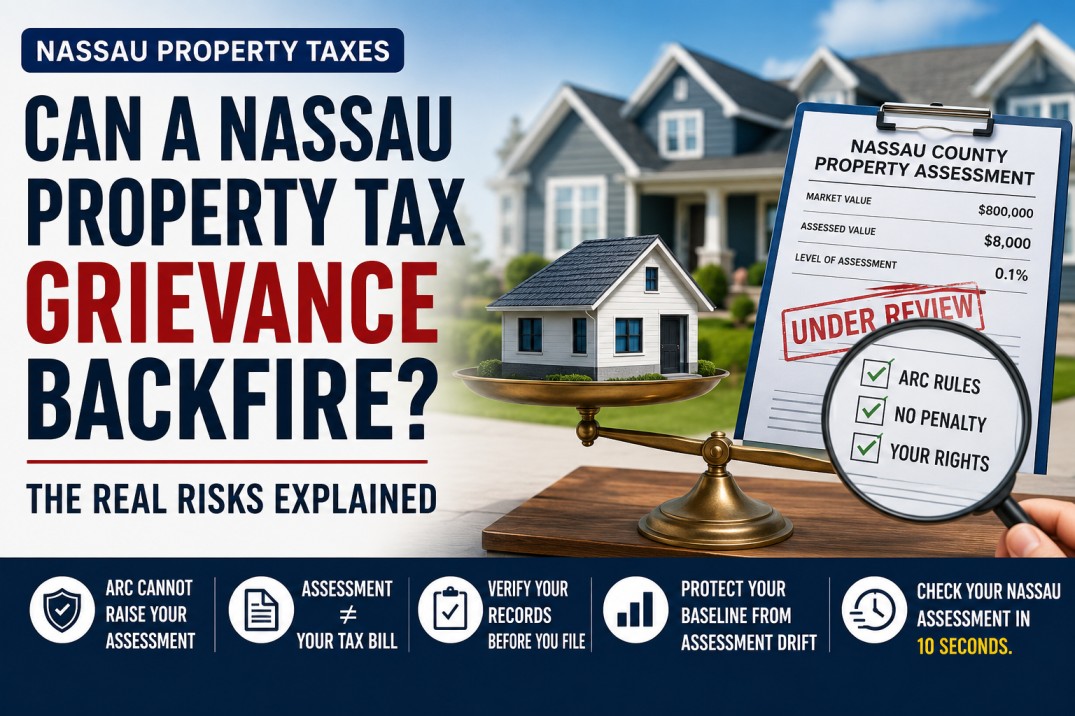
Under New York State Real Property Tax Law, and according to the operational rules of the Assessment Review Commission (ARC), there is zero risk that the ARC will increase your assessment as a direct result of your grievance filing.
For residential homeowners, a grievance is a one-way mechanism designed to challenge the current assessment and request a lower value. The practical result is either:
- A reduction; or
- A denial (no change).
However, homeowners should still verify their property-specific facts before filing, especially if the property has unusual records, recent unpermitted renovations, or exemption concerns.
Direct Answer: Can ARC Raise My Assessment?
No.
The Assessment Review Commission cannot raise your tentative assessment as a penalty or direct result of your residential grievance filing.
In ordinary residential cases, homeowners are filing to seek a lower assessment, not to invite a tax increase. If your grievance is denied, your assessment stays exactly where the county initially set it.
You have nothing to lose mathematically.
Before filing, homeowners should still confirm:
- Current ARC instructions and deadlines;
- Accuracy of the property assessment record;
- Whether the home had recent major improvements;
- Whether ownership or exemption details are accurate;
- Whether the property is a standard residential property.
The safest way to think about it:
Filing a grievance is a request to lower the current baseline. Before filing, homeowners should confirm that the County’s property record accurately reflects the home so the review process does not expose unrecorded improvements.
Assessment Is Not the Same as Your Tax Bill
Homeowners often ask:
“Can my taxes go up?”
But the more precise question is:
“Can my assessment go up?”
These are related, but not the same thing.
| Item | Meaning |
|---|---|
| Market Value | The County’s opinion of what the home is worth. |
| Assessed Value | The taxable assessment derived from Nassau’s valuation system. |
| Exemptions | Reductions based on eligibility (STAR, Veterans, Senior, etc.). |
| Tax Rate | Rates set by school districts and municipalities. |
| Tax Bill | Final amount owed after all calculations. |
A grievance challenges the Assessed Value only.
It does not directly affect:
- School budgets;
- Municipal budgets;
- Tax rates.
This means your tax bill can still rise because of:
- School tax increases;
- Municipal budget increases;
- Loss of exemptions;
- Special district charges.
Why Homeowners Worry (And When to Actually Be Careful)
The concern usually comes from situations where county records may not match reality.
1. The Home Was Recently Purchased
A recent sale price is strong evidence of market value.
- If you purchased below the County’s implied value, that supports your grievance.
- If you purchased above it, ARC will likely deny the filing unless the transaction was unusual (estate sale, foreclosure, non-arm’s-length transfer, etc.).
2. The Home Was Recently Renovated
Major improvements increase market value.
Examples include:
- Second-story additions;
- Finished basements;
- Large extensions;
- Significant modernization.
If the County record still reflects an older, smaller version of the property, filing may eventually lead the assessor to update the structural data in a future roll.
3. The County Record Is Wrong (In Your Favor)
Sometimes the County understates features.
Before filing, review:
- Gross Living Area (GLA);
- Lot size;
- Number of bathrooms;
- Property class;
- Number of units;
- Condition and grade data.
Example:
If the County thinks the property has 1 bathroom but the home actually has 3 renovated bathrooms, the discrepancy could eventually be corrected in a later assessment cycle.
4. Confusing Assessment With Taxes
Even if your assessment drops 5%, your tax bill can still increase if:
- School budgets rise;
- Municipal tax rates increase;
- Exemptions change.
That does not make the grievance ineffective.
Without the reduction, the tax increase could have been even larger.
What Filing Actually Does
A grievance asks ARC to review whether the County’s valuation is mathematically supportable.
Strong filings typically use evidence such as:
- Recent comparable sales;
- Nearby assessment equity comparisons;
- Property condition issues;
- Incorrect County records.
Weak filings usually say only:
“My taxes are too high.”
That argument is generally denied because it does not challenge the underlying assessed value.
The correct legal question is:
“Does the County’s implied Fair Market Value exceed what the evidence supports?”
What a Reduction Means
If ARC grants a reduction, the assessment is lowered for that assessment cycle.
The actual tax savings depend on:
- Size of the reduction;
- School tax rates;
- Municipal tax rates;
- Exemptions;
- Special district charges.
A lower assessment creates a lower taxable baseline going forward.
However, Nassau County reassesses annually, so reductions are not permanently locked in.
That is why many homeowners file every year.
Quick Pre-Filing Risk Check
Before filing, verify the following:
- The County property record is generally accurate;
- No major unrecorded renovations exist;
- You understand the grievance challenges the assessment, not the tax rate;
- You have evidence that the valuation is too high;
- Ownership and exemptions are current.
If those items check out, filing is generally a low-risk financial decision.
Frequently Asked Questions (FAQ)
Can my assessment go up because I filed?
No.
ARC cannot increase your residential assessment as retaliation or as a direct result of filing a grievance.
The worst outcome is simply no reduction.
Can my tax bill go up even if I win?
Yes.
Tax bills can still rise because of:
- School budgets;
- Municipal tax rates;
- Special district charges.
A grievance only reduces your share of the tax burden.
What if I recently bought the home for more than the assessment?
ARC will likely use the purchase price as evidence of market value and deny the grievance.
What if I renovated the home?
Review whether County records accurately reflect the renovation.
If the County substantially understates the home’s size or condition, filing may eventually trigger record updates in future cycles.
Do I need a lawyer?
No.
Most homeowners can file independently or use automated evidence-generation tools.
Final Takeaway
The idea that a Nassau property tax grievance can directly trigger a higher residential assessment is largely a myth.
For standard residential properties, the process is structurally one-directional:
- Either the assessment is reduced; or
- The assessment stays unchanged.
The larger long-term financial risk is often failing to challenge an inflated assessment baseline as values drift upward over time.
If the County’s valuation appears unsupported by comparable properties or neighborhood assessment patterns, filing is generally a rational financial defense.