Table of Contents
- Why the Filing Year and Tax Bill Year Are Different
- Tentative Assessment Roll: What Homeowners Should Review
- Grievance Filing Window: When to Prepare and Why Not to Wait
- ARC Review Period: What Happens After Submission
- Final Roll and Next Steps
- What to Do Before the Deadline
- DIY Filing vs. Full-Service Support
- Why FairValue Tracks the Timeline
- Frequently Asked Questions
- What is the Nassau County property tax grievance deadline for 2028/2029?
- When does Nassau County usually release the tentative assessment roll?
- What happens if I miss the deadline?
- Can I grieve a prior-year assessment?
- Can I amend my grievance after filing?
- Do I need a lawyer to file a Nassau tax grievance?
- Should I file every year?
- Does filing a grievance challenge my tax rate?
- Final Takeaway
If you are searching for the Nassau County property tax grievance deadline, the most important thing to understand is that the filing deadline is tied to the tentative assessment roll, not the tax bill currently in your mailbox.
For the 2028/2029 Nassau tax grievance cycle, the official filing window has not yet been announced as of this article’s last update. Homeowners should verify the final dates directly with the Nassau County Assessment Review Commission, known as ARC.
Historically, Nassau County publishes the tentative assessment roll in early January, and the grievance filing window runs during the early part of the year. However, the exact deadline can change by cycle, and recent Nassau deadlines have sometimes been extended. Do not rely on last year’s deadline without confirming the current ARC schedule.
FairValue will update this guide once the official 2028/2029 filing dates are available.
Why the Filing Year and Tax Bill Year Are Different
Nassau County’s property tax timeline can be confusing because the year you file is usually not the same as the year the tax bill is affected.
A homeowner may file a grievance in one calendar year for an assessment roll that affects future school and general tax bills.
For example:
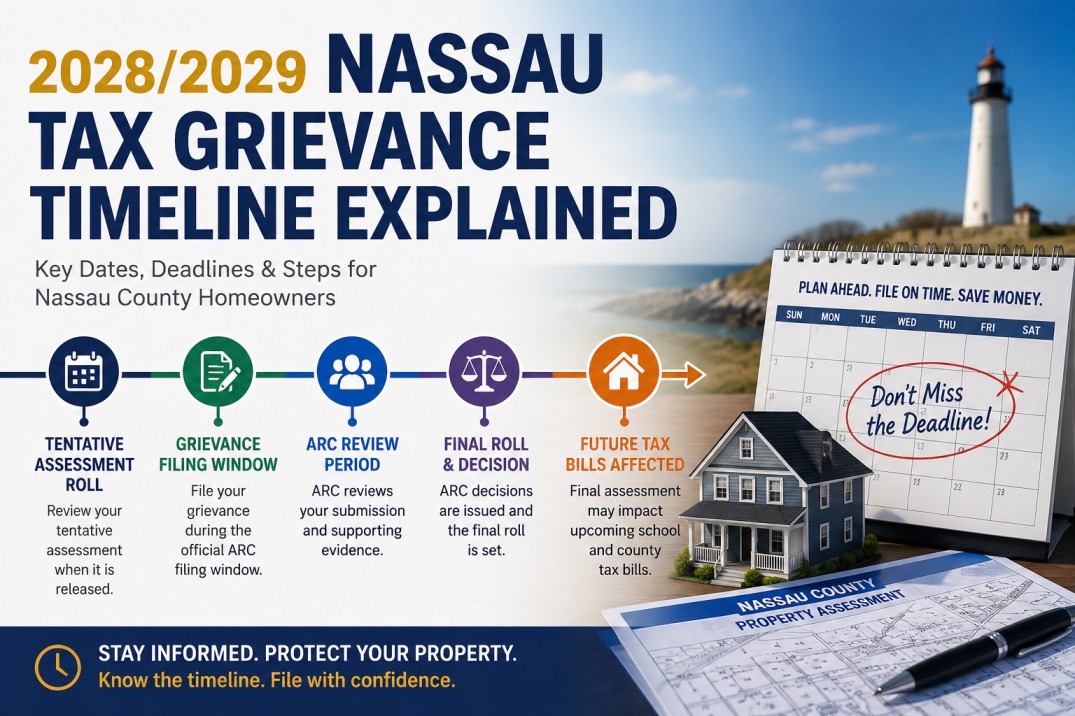
| Filing activity | What it means |
|---|---|
| Tentative roll is published | Nassau releases the new proposed assessment values. |
| Homeowner files grievance | The homeowner challenges the tentative assessment. |
| ARC reviews the filing | ARC reviews the homeowner’s evidence and decides whether a reduction is warranted. |
| Final roll is issued | The assessment becomes final for that cycle. |
| Future tax bills are affected | The finalized assessment can affect later school and general tax bills. |
This timing gap is why Nassau homeowners should not wait until they receive a high tax bill to start reviewing their assessment. By then, the grievance window for that assessment year may already be closed.
The practical rule is simple:
Review the tentative assessment roll when it is released, not after the tax bill arrives.
Tentative Assessment Roll: What Homeowners Should Review
The tentative assessment roll is the starting point for the grievance cycle.
When the roll is released, homeowners should review the County’s opinion of their home’s value and ask whether that value appears supported by evidence.
Review these items first:
- property address;
- owner name;
- Section, Block, and Lot, also known as SBL;
- property class;
- tentative assessed value;
- County-indicated market value;
- exemption status;
- building characteristics;
- lot size;
- living area;
- grade or condition indicators, if available;
- recent changes to the property record.
The most important question is not simply:
Did my taxes go up?
The better question is:
Does the County’s value for my home appear higher than comparable sales, similar nearby assessments, or property-specific facts support?
If the County’s value appears too high, the homeowner may have a reason to prepare a grievance.
Grievance Filing Window: When to Prepare and Why Not to Wait
The grievance filing window is the period when homeowners can submit their application to ARC.
For the 2028/2029 cycle, do not hardcode a date until ARC announces the official window. However, homeowners should assume that preparation needs to happen early in the calendar year.
Before the deadline, you should have enough time to:
- confirm the correct assessment cycle;
- review the County’s implied market value;
- gather comparable sales;
- compare similar nearby assessments;
- document property condition issues;
- decide whether to file DIY or use support;
- prepare the filing materials;
- submit before the deadline;
- save the confirmation receipt.
Missing the filing deadline can be costly because New York State guidance says only the assessment on the current tentative assessment roll can be grieved. Prior-year assessments generally cannot be challenged through the current grievance process.
That means if you miss the filing window, you may need to wait until the next assessment cycle.
ARC Review Period: What Happens After Submission
After a grievance is submitted, ARC reviews the filing and supporting evidence.
The review is not about whether Nassau County taxes feel too high in general. It is about whether the assessment assigned to the property appears too high based on evidence.
Evidence may include:
- recent comparable sales;
- similar nearby assessments;
- property-condition documentation;
- incorrect property characteristics;
- recent purchase price, where relevant;
- clear explanation of the requested reduction.
A strong filing is organized and specific. It should connect the County’s current value to the evidence supporting a lower value.
For example, a filing is usually stronger when it explains:
| Evidence type | What it helps show |
|---|---|
| Comparable sales | Whether the County’s market value is supported by recent sales. |
| Assessment equity | Whether similar nearby homes are assessed more favorably. |
| Property condition | Whether defects or deferred maintenance reduce value. |
| Correct property data | Whether County records overstate the property’s size, quality, or condition. |
After review, ARC may issue a determination that reduces the assessment, leaves it unchanged, or otherwise addresses the grievance based on the evidence submitted.
Final Roll and Next Steps
After the review process, Nassau County eventually finalizes the assessment roll for that cycle.
Once the roll becomes final, the assessment is used for future tax calculations. That is why the grievance process matters before the roll is finalized.
If the homeowner receives a reduction, the lower assessment may affect future school, county, town, and special-district tax bills, depending on the applicable tax cycle.
If the homeowner does not receive the expected result, possible next steps may include:
- reviewing ARC’s determination;
- saving all filing records;
- comparing the final value against the evidence;
- considering whether Small Claims Assessment Review, known as SCAR, may be available;
- preparing earlier for the next annual assessment cycle.
SCAR is a separate review path and has its own eligibility rules, filing requirements, and deadlines. Homeowners should verify those requirements before assuming they qualify.
What to Do Before the Deadline
A Nassau tax grievance should not be prepared at the last minute. The best time to prepare is before the filing window becomes urgent.
Use this pre-deadline checklist:
- Confirm the official ARC filing window.
- Review the current tentative assessment roll.
- Check the County’s implied market value.
- Compare recent nearby sales.
- Review similar nearby assessments.
- Check whether property records are accurate.
- Document any condition issues or deferred maintenance.
- Decide whether to file DIY or use full-service support.
- Prepare the evidence packet.
- Submit before the deadline.
- Save the filing confirmation.
The goal is not just to file a form. The goal is to submit a clear valuation argument before the deadline closes.
DIY Filing vs. Full-Service Support
Some Nassau homeowners file on their own. Others use support because they do not want to search for comparable sales, prepare evidence, or manage the filing process.
The right choice depends on the property and the evidence.
| Filing path | May fit when |
|---|---|
| DIY filing | You are comfortable using Nassau systems and preparing your own evidence. |
| DIY Evidence Pack | You want to file yourself but need organized comparable sales and assessment analysis. |
| Full-service support | The estimated savings are higher, the evidence is complex, or you want help managing the filing process. |
New York State guidance says there is no cost to grieve an assessment and that a lawyer is not required. However, many homeowners still prefer help organizing evidence or managing the process.
FairValue is designed to help with both paths.
Why FairValue Tracks the Timeline
FairValue helps Nassau homeowners review whether their property may be over-assessed before the filing deadline.
The platform reviews:
- Nassau property records;
- recent comparable sales;
- neighborhood assessment patterns;
- property-specific facts;
- estimated over-assessment signals.
Then it helps homeowners decide whether the better path is:
- DIY Evidence Pack — for homeowners who want to file themselves with organized support.
- Full-Service Grievance Support — for homeowners who want help managing the filing process.
The timeline matters because the best evidence is only useful if it is submitted before the filing deadline.
Frequently Asked Questions
What is the Nassau County property tax grievance deadline for 2028/2029?
The official 2028/2029 Nassau County property tax grievance deadline has not yet been announced as of this article’s last update. Homeowners should verify the current deadline with the Nassau County Assessment Review Commission.
When does Nassau County usually release the tentative assessment roll?
Nassau County has historically released the tentative assessment roll in early January. Homeowners should confirm the current cycle directly with Nassau County because dates and deadlines can change.
What happens if I miss the deadline?
If you miss the filing deadline, you generally lose the opportunity to challenge that year’s tentative assessment through the administrative grievance process. New York State guidance says only the assessment on the current tentative assessment roll can be grieved.
Can I grieve a prior-year assessment?
Generally, no. The annual grievance process is tied to the current tentative assessment roll, not prior-year assessments.
Can I amend my grievance after filing?
Amendment rules can depend on the filing system, timing, and ARC procedures for that cycle. Homeowners should check ARC’s current instructions before assuming they can add evidence later.
Do I need a lawyer to file a Nassau tax grievance?
No. New York State guidance says there is no cost to grieve an assessment and that a lawyer is not required. Some homeowners file themselves, while others use evidence-preparation or full-service support.
Should I file every year?
You should review your assessment every year. Each tentative roll is a new valuation cycle, and a prior reduction does not automatically prove the next assessment is still fair.
Does filing a grievance challenge my tax rate?
No. A grievance challenges the assessment, not school budgets, municipal budgets, or tax rates. The purpose is to review whether the assessed value assigned to your property is too high.
Final Takeaway
The Nassau County property tax grievance deadline is one of the most important dates for homeowners who want to challenge an unfair assessment.
For the 2028/2029 cycle, the official filing window has not yet been announced. Homeowners should verify the deadline with Nassau County ARC and prepare early by reviewing the tentative assessment roll, comparable sales, nearby assessment equity, and property-specific evidence.
Do not wait until the final week to decide whether your assessment is worth challenging.