Taxes vs. Assessment
FairValue focuses on the assessment evidence, not just the size of the tax bill.
FairValue Tax Appeal helps Nassau County homeowners move beyond the vague feeling that property taxes are too high. Our methodology reviews whether the assessment itself may be higher than the evidence supports, using public property records, comparable sales, assessment equity analysis, and AI-assisted evidence organization.
The goal is not to replace official review, legal advice, or homeowner judgment. The goal is to make the evidence clearer, more systematic, and easier to understand before choosing a filing path.

Review framework
Records, sales, equity, documentation
A high tax bill does not always mean the assessment is contestable. A useful review asks a narrower question: does the County's assessment appear high when compared with relevant sales, similar properties, and documented property-specific factors?
FairValue focuses on the assessment evidence, not just the size of the tax bill.
Comparable sales help test whether the County's implied market value appears supported by recent local evidence.
Similar-home comparisons help identify whether a property may be assessed differently from comparable neighbors.
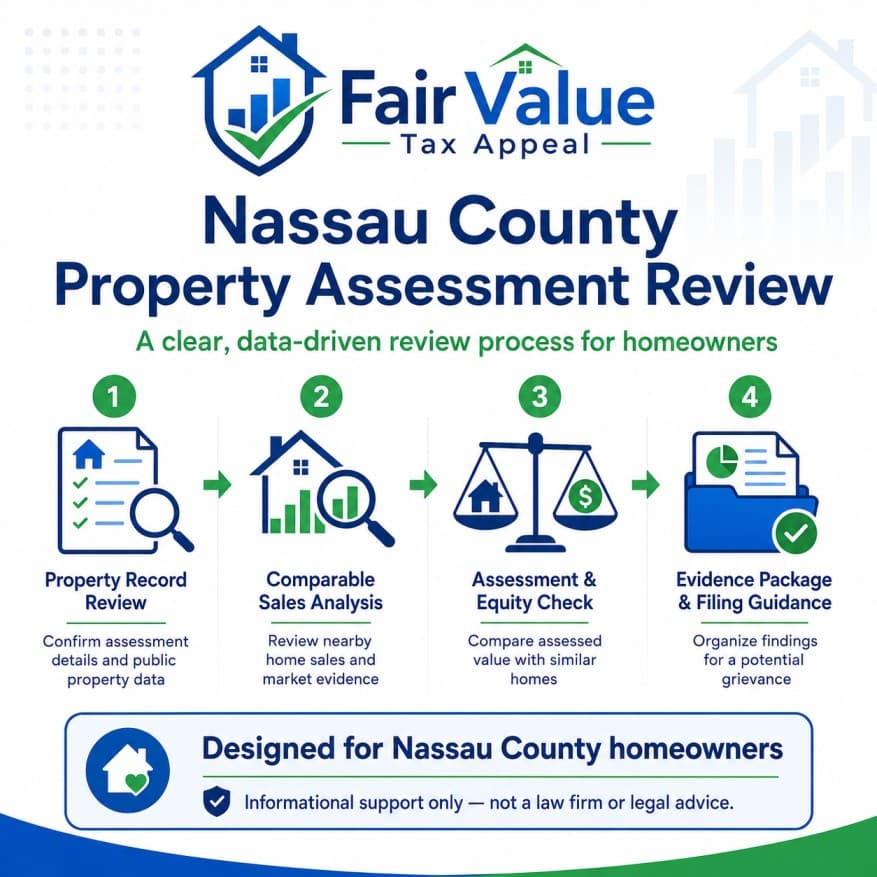
We start with public assessment records and property characteristics to understand the County's current valuation basis.
We identify relevant nearby sales and examine whether they support or challenge the County's market-value estimate.
We compare assessment patterns among similar homes to look for possible imbalance or outlier signals.
Where documented and relevant, we consider condition, layout, renovation status, or other factors that may affect valuation.
We organize the findings into a clear evidence package or filing-support workflow, depending on the homeowner's selected service path.
FairValue's review is based on available data, not generic assumptions. The specific data available may vary by property and timing.
FairValue does not create official assessment records and does not control County data. Homeowners should verify official records, deadlines, and filing requirements with the appropriate Nassau County sources.
For more about the team behind this approach, visit About FairValue Tax Appeal.
Comparable sales are used to test whether the County's market-value estimate appears consistent with recent nearby transactions. FairValue reviews sales context, property similarity, timing, and obvious differences that may affect comparison quality.
Not every nearby sale is a good comparable. The methodology prioritizes relevance over simply listing the closest or highest-impact sale.
A property can appear high not only because of market-value evidence, but also because similar homes show lower assessment patterns. FairValue reviews whether the subject property appears meaningfully out of line with comparable residential properties.
FairValue uses generative AI to help organize data-driven findings into plain-English evidence narratives. The AI does not invent comparable sales, make legal conclusions, or guarantee outcomes. It helps transform structured analysis into clearer homeowner-facing documentation.
Technology is useful only when it is grounded in real evidence. FairValue's process is designed to combine structured data analysis with practical review of whether the evidence appears coherent, relevant, and useful for a homeowner considering a grievance.
If you want to see whether your property shows appeal signals, start with the Nassau County property tax grievance help page. You can review the support options, understand what FairValue analyzes, and begin a property-specific assessment review.
Question 1
No. AI is used to help organize and explain data-driven findings. Filing decisions remain the homeowner's choice and should be based on the evidence, timing, and any professional advice the homeowner chooses to seek.
Question 2
No. FairValue provides assessment analysis and evidence organization. It does not provide a certified appraisal unless the business later adds that service through properly qualified professionals.
Question 3
The review uses available public records, assessment data, sales information, property characteristics, and homeowner-provided information. Data availability and accuracy may vary by property.
Question 4
No. The methodology can identify appeal signals and organize evidence, but it cannot guarantee a reduction or control the outcome of any County review.
Question 5
Equity analysis helps compare a property with similar homes to see whether its assessment appears out of line with nearby assessment patterns.
Question 6
No. FairValue is not a law firm and does not provide legal, financial, or tax-return preparation advice. The service provides property assessment analysis and informational support.